Commercial interior design isn’t just about making a space look good, it’s about creating an environment where employees thrive, clients feel welcomed, and your business operates efficiently. Unlike residential projects, commercial interiors must balance aesthetics with strict functional requirements, safety codes, and budget constraints. Whether you’re opening a retail shop, redesigning an office, or upgrading a restaurant, understanding the fundamentals of commercial design can mean the difference between a space that works and one that hemorrhages money. This guide walks you through the essentials, from planning and budgeting to solving real-world design challenges you’ll actually encounter on the job.
Table of Contents
ToggleKey Takeaways
- Commercial interior design prioritizes functionality, compliance, and efficiency over aesthetics alone, requiring adherence to building codes, ADA standards, and safety regulations that residential projects rarely encounter.
- Successful commercial projects demand upfront planning including clear project briefs, detailed budgeting ($150–$300 per square foot), and realistic timelines that account for permitting delays of 4–8 weeks.
- Effective zoning and workflow optimization—blending private focus areas, collaborative spaces, and social zones—are essential to preventing open-plan office failures and maximizing operational productivity.
- Material and durability specifications must align with actual use intensity: commercial-grade finishes, acoustic solutions, and proper layered lighting are investments that prevent costly premature replacements and maintain brand identity.
- Early involvement of accessibility consultants and coordination of mechanical, electrical, and structural systems through detailed 3D models prevents code violations, lawsuits, and expensive mid-construction rework.
Understanding Commercial Interior Design Fundamentals
Commercial interior design is the practice of planning and executing functional, compliant spaces for businesses, offices, retail stores, restaurants, warehouses, and more. It’s fundamentally different from decorating a bedroom. Commercial projects must satisfy building codes (local, state, and national standards like the International Building Code or IRC), accessibility requirements (ADA compliance), fire safety regulations, and electrical standards (NEC, the National Electrical Code). Before a single design element gets considered, the space must be safe, legal, and workable.
The scope includes everything: spatial planning, material selection, lighting design, HVAC considerations, acoustics, flooring systems, and security infrastructure. A commercial designer (or team including architects, engineers, and specialists) evaluates traffic flow, task-specific lighting needs, durability requirements, and budget constraints simultaneously. Color choices matter, but they come after solving whether the layout allows staff to move smoothly or if the flooring can withstand foot traffic. That’s the real heart of commercial work, function drives form, not the other way around.
Key Differences Between Commercial and Residential Design
The biggest distinction: commercial spaces are performance assets, not personal sanctuaries. A residential kitchen serves a family: a commercial kitchen must serve dozens of covers per hour while meeting health codes and equipment placement standards. Residential design prioritizes personal taste and comfort: commercial design prioritizes occupant safety, operational efficiency, and legal compliance.
Commercial projects also operate on different timelines and budgets. Residential renovations might take 8–12 weeks: commercial buildouts can run 6–18 months depending on scope. A small office refresh might cost $50,000: a full restaurant redesign can exceed $500,000. Residential designers often work with homeowners directly: commercial projects involve architects, contractors, building departments, and sometimes multiple stakeholders (landlords, lenders, local authorities).
Materials differ too. Residential carpet might wear out in 7–10 years: commercial carpet must survive 10–15 years of daily abuse and come with commercial-grade warranties. Residential paint is consumer-grade: commercial paint is often low-VOC (volatile organic compound), fire-rated, or antimicrobial. Residential lighting can be decorative: commercial lighting must meet foot-candle requirements for safety and task performance. Modern Interior Design: Transform explores aesthetic trends, but commercial projects layer compliance and durability into every decision.
Planning Your Commercial Project: Budget, Timeline, and Goals
Start with a clear project brief. Define the purpose of the space, the number of occupants, daily usage patterns, and specific business activities. Is this a call center requiring acoustic privacy? A retail showroom needing high-impact lighting? A warehouse demanding durable, easy-to-clean surfaces? Clarity here prevents costly mid-project pivots.
Budgeting for commercial projects requires line-item thinking. Allocate funds across hard costs (construction, materials, equipment) and soft costs (design fees, permits, inspections, contingency). A typical commercial renovation runs $150–$300 per square foot depending on location and scope, but that’s a rough starting point, your actual costs depend on existing conditions, material grades, and local labor rates. Always reserve 10–15% contingency for surprises: hidden structural issues, code-driven changes, or supply chain delays.
Timeline planning must account for permitting. A simple cosmetic refresh might need only interior permits: structural changes, HVAC work, or electrical upgrades require building permits and inspections that can add 4–8 weeks to your schedule. Office Interior Design: Transform covers workspace-specific planning, but all commercial projects demand a realistic project schedule with built-in buffer time. Coordinate with contractors, manufacturers, and building inspectors early to avoid delays.
Essential Design Elements for Commercial Spaces
Functionality and Workflow Optimization
Every square foot must earn its keep. Start by mapping traffic patterns and workflows. In an office, can employees reach the restroom without cutting through a meeting area? In a retail space, does the layout guide customers naturally through high-margin products? In a restaurant, is the kitchen positioned to minimize travel time between stations?
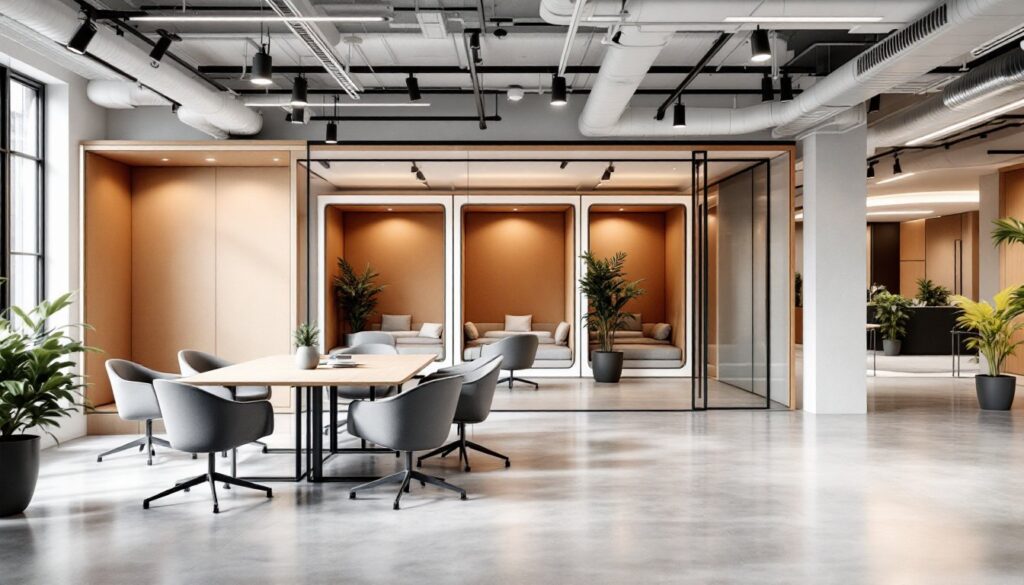
Zoning is critical. Designate areas for focused work, collaboration, client interaction, storage, and support functions. Open office layouts sound cost-effective but fail when there’s no quiet space for concentration calls. Conversely, private offices for everyone create silos and waste space. Most successful commercial designs blend zones: private offices or focus pods for concentration, collaborative areas for teamwork, and social spaces for informal meetings. Lighting, acoustics, and furniture choices reinforce these zones and their purposes.
Storage and support infrastructure often get overlooked in initial sketches but create chaos if undersized. Calculate document storage, equipment, supplies, and equipment based on actual inventory. A dental office without adequate sterilization space doesn’t function. A retail store without back-of-house staging fails at restocking.
Brand Identity and Visual Consistency
Commercial spaces are brand ambassadors. Color palettes, materials, typography, and lighting should reflect the business’s identity and set the right tone for clients and staff. A law firm needs trust and professionalism: a tech startup might embrace innovation and energy. Neither approach is better, they just serve different purposes.
Consistency matters across touchpoints. Reception areas, meeting rooms, bathrooms, and break rooms should feel cohesive even as their functions differ. This doesn’t mean everything is identical: it means a unified design language, perhaps consistent flooring, coordinated color accents, or recognizable logo integration. Materials like wood species, stone finishes, and metal fixtures should be thoughtfully repeated or deliberately contrasted, not random. Interior Design Styles: Discover discusses aesthetic frameworks: commercial applications add operational constraints. Your brand identity must also survive heavy use, regular maintenance, and staff learning curves. A pristine white tile floor looks stunning but demands constant cleaning, realistic for a showroom, impractical for a high-traffic production facility.
Common Commercial Design Challenges and Solutions
Acoustic Control: Open floor plans create noise pollution that tanks productivity. Solution: Invest in acoustic panels, fabric-wrapped walls, carpet (absorbs sound better than hard flooring), and strategic placement of solid walls around noisy equipment or high-traffic zones. Headphones and white noise systems are Band-Aids, not fixes.
Budget Overruns: Scope creep, “while we’re at it, let’s also…”, destroys commercial timelines. Solution: Lock down requirements upfront, document all change orders in writing with cost and schedule impact, and maintain a clear contingency reserve. Surprises (asbestos, hidden structural damage, code violations) will happen: manage them proactively.
Lighting Mistakes: Too-dim lighting makes offices feel depressing: too-bright creates glare and eye strain. Task lighting is essential: ambient lighting alone doesn’t cut it. Solution: layer lighting, ambient (ceiling), task (desks, workstations), and accent, and use 4000K–5000K color temperature for offices (feels neutral and energetic). Dimming controls let staff adjust comfort throughout the day. Remodelista’s commercial space design guide and Curbed’s office design showcase demonstrate how professional projects balance multiple priorities.
Durability vs. Aesthetics: Cheap finishes look shabby after months: premium finishes blow budgets. Solution: Specify commercial-grade materials rated for your specific environment. A restaurant kitchen needs stainless steel and sealed concrete: a law office lobby can use high-end laminates or stone because foot traffic is lighter. Match material durability to actual use intensity and maintenance capacity.
ADA and Code Compliance: Ramps, doorway widths, restroom accessibility, and emergency egress aren’t afterthoughts. Solution: involve an accessibility consultant early. Violations invite lawsuits and costly retrofits. Codes vary by jurisdiction, so confirm requirements with your local building department before design work begins. Home Bunch features luxury interiors, but even high-end commercial projects must pass inspections.
Coordination Between Trades: Electricians, HVAC, plumbing, and structural work all compete for ceiling and wall space. Solution: require a detailed 3D model or floor plans from your architect showing mechanical, electrical, and structural systems. Conflicts caught in planning save weeks and thousands in rework during construction.