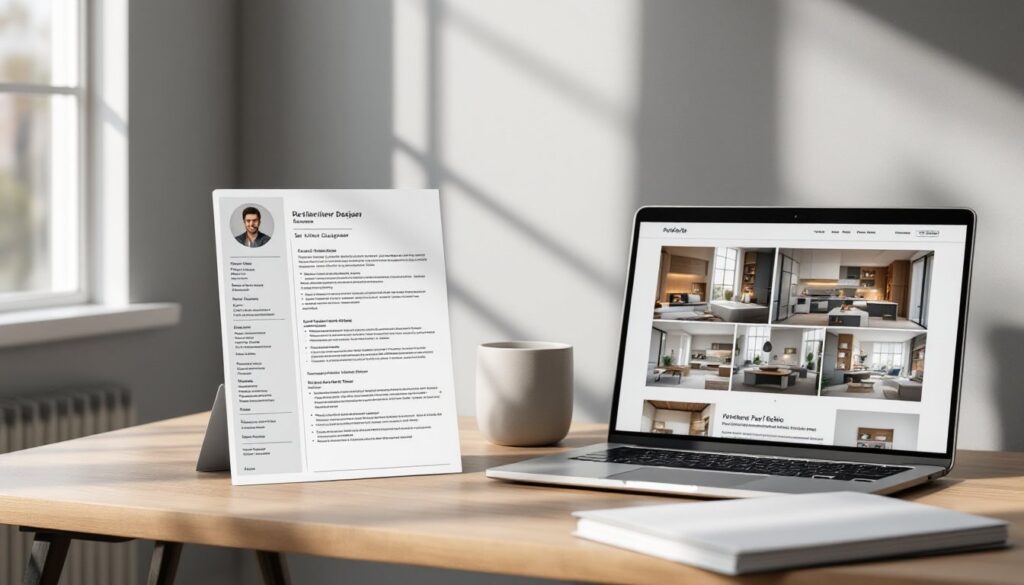
Your interior design resume is your first and often only chance to demonstrate your creativity, technical expertise, and understanding of design principles to potential employers or clients. Unlike a generic resume, an interior design resume must showcase not just experience and education, but also your design eye, technical proficiency, and ability to solve real-world spatial problems. Whether you’re launching your career, transitioning into a new design specialty, or competing for a high-profile position, your resume needs to stand out in a competitive field. This guide walks you through building a resume that captures your skills, projects, and professional value with the same attention to detail you’d bring to a space design.
Table of Contents
ToggleKey Takeaways
- An interior design resume must balance hard skills (software proficiency, technical knowledge) with soft evidence of creative vision, quantifiable project outcomes, and client results to stand out in a competitive field.
- Your professional summary and skills section should be concrete and specific—anchor value to measurable achievements like ‘maintained 95% client satisfaction rating’ rather than generic statements about being a ‘creative designer.’
- Tailor your interior design resume to the target position by creating 2-3 versions that emphasize relevant skills and projects: highlight residential expertise for boutique firms, commercial code knowledge for corporate roles, and niche specializations like healthcare or hospitality design.
- Each project description should showcase your specific role, key design decisions or challenges solved, materials and finishes selected, and measurable outcomes—keeping descriptions to 2-3 sentences maximum.
- Use a clean, scannable layout with clear hierarchy, consistent spacing, and readable fonts (10-12 point minimum) while formatting for both human readers and applicant tracking systems using standard section headings and PDF submission.
- List software proficiency honestly with proficiency levels (e.g., ‘AutoCAD intermediate’) and include construction terminology, budget management, and hands-on skills that demonstrate your ability to work with actual materials and contractors alongside digital tools.
Understanding What Your Interior Design Resume Needs to Include
Your interior design resume serves a dual purpose: it tells the story of who you are as a designer while proving you have the credentials employers want. Unlike resumes for general positions, yours must balance hard skills (software proficiency, technical knowledge) with soft evidence of creative vision (project outcomes, client results). Start by understanding that design firms, corporate in-house teams, and independent client bases all expect different information emphasized differently. A small boutique firm may care deeply about your personal design philosophy, while a corporate workspace design company prioritizes your experience with commercial projects and code compliance. The foundation of your resume should include clear, honest information about education, certifications, professional experience, and measurable design contributions you’ve made to projects.
Essential Resume Sections for Interior Designers
Contact Information should include your name, phone number, email, city/state (not your full address), and links to your portfolio or professional website. Many designers now add a link to their professional Instagram or Behance profile if it’s polished and current. Keep this section clean and easy to scan, hiring managers should find your information in under five seconds.
Professional Summary (4-6 lines) is your elevator pitch. Write this last, after you’ve completed the rest of your resume. Instead of generic statements like “Creative designer with passion for beautiful spaces,” anchor it to concrete value: “Interior designer specializing in residential renovation with 7+ years’ experience managing projects from concept through installation. Proficient in AutoCAD and SketchUp: successfully increased client retention by 40% through detailed consultation processes.”
Core Competencies or Skills should list both technical and soft skills, but stay specific. Instead of “design skills,” list “space planning, color theory, materials selection, residential design, commercial design, and project management.” Include software names: AutoCAD, SketchUp, Revit, Adobe Creative Suite, Vectorworks, or whatever tools you actually use competently. Avoid inflating this section: be honest about your proficiency level.
Professional Experience is where you demonstrate impact. Rather than listing job duties (“Responsible for client consultations”), describe measurable outcomes and specific contributions (“Led 12+ full-scale residential renovations annually: managed budgets up to $150K: maintained 95% client satisfaction rating”). Quantify when possible: number of projects, budget size, timeline compression, client retention, or quality improvements you implemented.
Education and Certifications belong here. List degrees (AA/BA in Interior Design), NCIDQ certification (if you have it), and relevant continuing education. If you have a degree in a different field, include it, it shows depth, but prioritize design-specific education and credentials near the top.
Portfolio and Project Highlights should appear as a short section directing readers to your full portfolio. One sentence: “Portfolio available at [yourportfoliosite.com] featuring 15+ residential and commercial projects.” This is your gateway to showing your actual work.
Showcasing Your Design Skills and Technical Proficiencies
Employers in 2026 expect interior designers to be software-literate, but they care most about what you can do with the tools, not just which buttons you can press. List software realistically: if you’ve used AutoCAD for basic floor plans but aren’t fluent in complex detailing, say “AutoCAD (intermediate)” or “AutoCAD (floor planning and basic elevations).” Honesty prevents you from being hired into a role expecting advanced expertise you don’t have.
Beyond software, highlight design knowledge categories that matter to the role you’re pursuing. For residential design, emphasize space planning, color psychology, and material durability. For commercial or hospitality design, stress knowledge of building codes, ADA compliance, and finish specifications. If you have certifications in sustainable design, accessibility compliance (LEED, WELL Building Standard, or ADA), or specialized material knowledge, feature them prominently.
Include both digital and hands-on skills. Can you sketch by hand? Do you have a strong eye for proportion, layout, and flow? Have you worked with textile samples, paint chips, and material libraries? These matter to hiring managers, many still encounter designers who are software-savvy but struggle when faced with actual material decisions. Show that you understand construction terminology (stud framing, soffit, dado rail, underlayment) and can communicate with contractors and suppliers. Mention any experience with budget management, supplier relationships, or project scheduling software like Asana, Monday.com, or Microsoft Project if you’ve used them.
If you specialize in a particular niche, kitchen and bath, commercial hospitality, corporate workplaces, healthcare design, residential styling, state it. The more specific you can be about your strengths, the better you’ll rank for the roles you actually want. Designers with deep expertise in Modern Interior Design: Transform or Office Interior Design: Transform tend to stand out in their niches.
Highlighting Your Portfolio and Project Experience
Your portfolio is the real resume: your written resume is just the introduction. But here’s the critical piece: your written resume must guide viewers to understand what they’re looking at. Each project you list should be anchored to your contribution, the challenge you solved, and the outcome.
Crafting Compelling Descriptions of Your Interior Design Projects
Instead of “Led design for residential kitchen renovation,” write something like: “Designed and oversaw renovation of 280-sq.-ft. kitchen for high-end residential client: selected finishes (custom cabinetry, quartz counters, Carrara marble backsplash) within $45K budget: coordinated with contractor through 14-week installation: client praised the functional layout and material longevity.”
For each project you list, include:
- Project type and scope (residential, commercial, hospitality, office: square footage: budget if relevant)
- Your specific role (designer, lead designer, junior designer, be honest about seniority)
- Key design decisions or challenges (Did you solve a flow problem? Work around a structural constraint? Maximize a small space?)
- Materials, finishes, or techniques you selected or specified
- Outcome (client feedback, how the space functions, any awards or recognition, time/budget performance)
Keep each description to 2-3 sentences maximum. Your portfolio should show visual proof: your resume explains the thinking.
If you’ve worked on projects you can’t showcase publicly due to NDAs, describe them generically: “High-end residential residence, 3,500+ sq. ft., managed client expectations and design timeline across 18-month project.” Employers understand confidentiality and will respect your discretion.
Include personal or student projects if they’re strong, a portfolio doesn’t have to be exclusively paid professional work. A standout student renovation or self-directed design project can show initiative and taste. Link directly to your portfolio website or platform. Platforms like Houzz and Elle Decor both feature designer portfolios, and many hiring managers are familiar with how they work. If your portfolio lives on a personal website, ensure the site loads fast, is mobile-friendly, and displays images at high quality.
Tailoring Your Resume for Different Interior Design Roles
A single resume won’t serve you well if you’re applying to wildly different roles. Create 2-3 versions of your resume, each emphasizing different skills and projects depending on the position. For a residential design role at a boutique firm, emphasize client communication, bespoke finishes, and small-space expertise. For a commercial workplace design position, highlight code knowledge, large-scale project management, and sustainability certifications.
Read the job posting carefully. If it mentions “proficiency in Revit and coordination with contractors,” your resume should explicitly call out those skills and relevant experience. If it stresses “color theory and residential styling,” reorder your skills section to lead with that expertise. This isn’t dishonest, it’s strategic emphasis on the parts of your background that actually matter to that employer.
Career stage also affects your resume strategy. Early-career designers (0-3 years) should emphasize education, internships, and the best student or entry-level projects. Mid-career designers (5-10 years) can lead with significant projects, client outcomes, and specialized expertise. Senior designers (10+ years) should focus on leadership, team management, and major projects or awards, less detail on daily tasks, more on strategic impact. If you’re transitioning into a new niche, explain the bridge: “Background in residential design: completed advanced training in commercial workplace design and ADA compliance: seeking to leverage spatial planning expertise in corporate environment.”
Research the firm’s focus and recent projects before submitting. An interior design company known for Scandinavian Interior Design: Transform wants to see that aesthetic and philosophy reflected in your portfolio and professional summary, not your resume alone.
Formatting and Design Tips to Make Your Resume Stand Out
Your resume’s design matters, but don’t let it overshadow readability. A designer’s resume should be visually competent without being a portfolio piece itself. Use a clean layout with clear hierarchy: bold section headings, consistent spacing, and a readable font (10-12 point minimum). Avoid trendy fonts or excessive color. Two or three colors max: black and one accent color is safest. Hiring managers and recruiting software both scan resumes, so a cluttered design reduces your chances of being seen.
Keep your resume to one page if you have less than 7-8 years of experience: two pages is acceptable for mid-to-senior-level designers with substantial project history. Use white space strategically. Dense paragraphs of text are hard to scan: break information into short lines and bullet points.
Include a professional headshot or just your name at the top, avoid casual photos or your Instagram picture. If you include an image, ensure it’s high-resolution and professional.
Format for both human eyes and applicant tracking systems (ATS). ATS software scans for keywords, so use standard section headings (“Professional Experience,” “Education,” “Skills”), avoid fancy graphics or tables, and use standard fonts. Save your resume as a PDF to preserve formatting across systems.
Proofread ruthlessly. A single typo on a designer’s resume screams carelessness. Have someone else review it. Check that project names, software names, and certifications are spelled correctly. Verify dates, titles, and employer names against your official records.
Finally, consider the platform. For online applications, follow the employer’s format guidelines (some ask for PDF, some want a specific format). For networking or personal outreach, you might send a PDF with a link to your portfolio website. Interior Design Jobs: Unlock often list specific submission requirements, follow them exactly. And if you’re serious about the role, research Interior Design Salary: Discover How Much Designers Really Earn expectations for that position and region so you know what you’re aiming for. Resources like Decoist showcase design trends and styles: if the firm’s work aligns with current industry aesthetics you see there, your resume should subtly reflect similar sensibilities. Finally, explore the broader Interior Design Tips: Transform Your Space into a Personal Sanctuary landscape to understand the kinds of design conversations happening in your market.